


PMOs play a critical role in driving strategic, cross-functional work that keeps the business moving forward. But as AI begins to impact how organizations plan, prioritize, and deliver, the expectations placed on PMOs are changing fast.
PMOs are heading toward two possible futures: evolve their value through AI or risk being outpaced by more adaptive, AI-enabled parts of the organization. Many leaders recognize the opportunity, but knowing where to start and how to demonstrate measurable value is often the hardest part.
Even with clear interest and intent, teams often struggle to move beyond manual processes, disconnected experimentation, varying levels of comfort with AI tools, and uncertainty about how to apply AI in portfolio management. Without a structured approach, these challenges can stall progress before real impact is achieved, widening the gap between AI-ready PMOs and everyone else.
The path forward starts with clarity: understanding your PMO’s current AI maturity, identifying practical use cases where AI can make a measurable difference, and taking focused steps to integrate those capabilities into the PMO team’s everyday work. Done right, your PMO can evolve into a smarter, more strategic resource that drives clarity, speed, and measurable results for your organization.
“AI will redefine how PMOs deliver value—accelerating insight, precision, and impact. The real risk isn’t in exploring AI, it’s in waiting too long to start.”
In this blog, we walk through three steps to help PMO leaders move from interest to impact:
- Assess your PMO’s AI maturity to understand your starting point.
- Identify the right use cases that deliver measurable value.
- Build a roadmap that scales AI across your portfolio.
# Step One: Understand Your PMO’s AI Maturity
Before thinking about use cases or tools, start by understanding your PMO’s current AI maturity. AI maturity measures how effectively your PMO uses AI to achieve business goals, considering not only data and systems but also workforce readiness, governance, and comfort using AI tools.
The maturity journey unfolds progressively across five stages. The goal isn’t to jump straight to the top, but instead to make steady progress by introducing the right kinds of AI support as your PMO evolves.
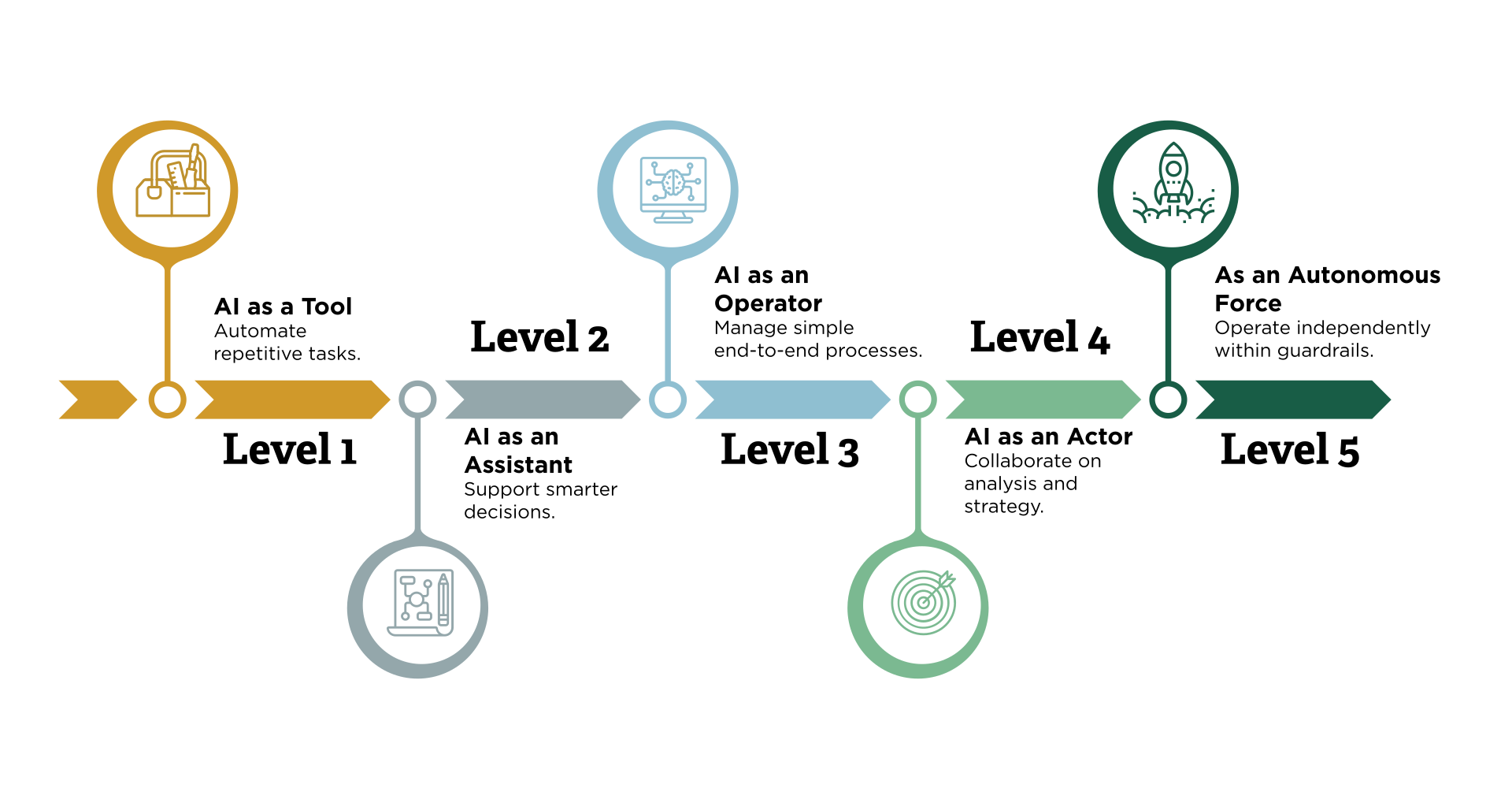
Image Source: IDC, “Agentic AI Impact on Enterprises: From the Tech Stack to the Future of Work and Services”
Level 1: AI as a Tool
At this stage, organizations are using AI to automate repetitive work. Applying AI to specific, repeatable tasks — like drafting meeting summaries, action items, or status updates — can save valuable time and reduce manual effort, freeing your team to focus on higher-value analysis and collaboration.
Level 2: AI as an Assistant
AI begins to support more informed decision-making, serving as an extra set of eyes to rapidly interpret diverse information. For example, AI might score project requests based on their alignment with business goals or their impact on resource availability.
Level 3: AI as an Operator
Here, AI starts managing simple processes end-to-end. It might generate recurring status reports or review project updates to identify potential risks, improving consistency and efficiency across portfolios.
Level 4: AI as an Actor
Within more advanced organizations, AI takes on proactive roles. Agentic tools perform targeted analysis, flag opportunities or bottlenecks, and even collaborate with teams on strategy. For example, agent tools could handle specific analyst functions within a project, expanding the PMO’s reach and accelerating decision-making.
Level 5: AI as an Autonomous Force
In this future state, AI operates independently within predefined ethical and governance guardrails — executing strategic tasks, responding dynamically to change, and continuously learning from outcomes. While few PMOs are here today, the technology is evolving quickly, and the full range of possibilities is still emerging. This uncertainty makes it all the more important to build strong foundations now.
Want a quick way to assess your PMO’s AI maturity?
Propeller’s AI Maturity Workshop
helps teams identify where they are today and chart a path forward in just three hours.
# Step Two: Identify the Right Use Cases for Your PMO
Once you understand your PMO’s current AI maturity, the next step is identifying where AI can create a meaningful impact. The most effective AI strategies focus on the use cases that align with your organization’s readiness, resources, and strategic priorities. Not every PMO should begin in the same place.
For example, teams early in their AI journey might focus on automating repetitive tasks or improving reporting speed. More advanced PMOs can explore hosting recurring trainings on new tools, predictive analytics, resource optimization, and scenario modeling that inform strategic decisions.
Use the examples below to explore where AI can bring the most value across core PMO functions. Each use case is tied to measurable business outcomes and reflects the maturity level at which it typically becomes practical to implement.
The goal isn’t just efficiency. It’s also about using AI in creative ways that help your teams support strategic objectives and deliver new forms of value.
“You don’t have to start with high-stakes AI projects. Sometimes the most valuable use cases begin as creative experiments that make people’s jobs easier or more fun, like using AI to provide regular coaching and feedback on draft communications, and those often turn into scalable wins.”
# AI Use Cases Across Core PMO Functions
Each use case is connected to measurable business outcomes and includes the maturity level at which it typically becomes practical to implement.
PMO Function | Example AI Application | Expected Outcomes | Maturity Level |
|---|---|---|---|
| Intake | Build a simple AI form to score new project requests based on cost, timeline, and alignment. | Faster intake process, more consistent scoring, less manual sorting, and improved consistency in applying evaluation criteria. | Level 2 |
| Prioritization | Ask AI to rank projects using cost, effort, and strategic value, drawing on data already tracked in your PMO tool. | Support stronger conversations with leadership. | Level 1→2 |
| Decision-Making | Use chat-based analysis to answer, “Which projects need executive attention this week?” | Support stronger conversations with leadership. | Level 2 |
| Reporting | Generate one-page summaries of project or portfolio health using AI. | Reduction of time spent on drafts | Level 1 |
| Risk Aggregation & Management | Aggregate risks from individual projects and use AI to identify portfolio-level systemic risks. | Earlier awareness of project risks, stronger, fact-based risk planning, and reduced firefighting late in delivery. | Level 1 |
| Resource Management | Forecast resource demand based on task-level schedules and allocations | Improved capacity planning, reduction in resourcing conflicts, and smoother workload distribution across teams. | Level 2 → 3 |
Resource: Download How AI Elevates PMO Functions and Skillsets for a deeper look at how AI enhances the people, processes, and tools that drive your portfolio’s success.
Once you’ve identified a few
promising areas for AI applications, the next step is to prioritize them and
create a practical plan for testing and scaling.

PMO AI Use Case Guide
A quick guide to the AI use cases that can strengthen core PMO functions.
# Step Three: Build a Roadmap to Scale AI Across Your PMO
Most PMOs we see are at Levels 1 or 2 of AI maturity — using AI in portfolio management primarily for efficiency gains or early decision support. Advancing toward predictive and strategic use cases won’t happen overnight, but with the right focus and foundation, steady progress can transform how your PMO delivers value.
Once you’ve identified potential use cases, the next step is to bring them to life through focused, achievable progress. These five steps provide a structured path to move from early experimentation to integrated, organization-wide adoption. Each step builds the last, helping your PMO increase confidence, capability, and value along the way.


# 5 Steps to Advance PMO AI Maturity
1. Assess and prepare for AI adoption
Start by defining your vision. Where do you want to be on the maturity curve in six to twelve months? Identify one or two focus areas within your department that clearly align with your organization’s business strategy.
Create a walking deck with simple visual linking your AI goals to expected outcomes to help align stakeholders early. For example, a PMO might align its AI initiatives to a North Star such as improving delivery efficiency or transitioning from a reactive PMO to a predictive PMO.
2.Select use cases
Not every PMO capability will benefit from AI, and what works in one PMO won’t create the same value in another. AI should enhance your PMO’s ability to deliver planned work and achieve planned objectives. The AI initiatives that succeed are those that connect directly to measurable business outcomes, like faster decision cycles or reduced reporting time.
Consider creating an AI opportunity list where your team can create a backlog of AI activation ideas ready for automation using data you already collect. Then, prioritize one use case that will create quantifiable and visible value for your teams, as this will be the easiest way to build momentum.
“In my experience working with PMOs at Fortune 500 organizations, success with AI comes from focus, not scale. Start with one clear use case, prove its impact, and use that momentum to fuel broader transformation.”
3. Assess the current landscape
As you start exploring AI in portfolio management, take stock of your existing data, systems, tools, and guardrails. Audit core resources, like your project registers, resource plans, and risk logs, to confirm they’re consistent and in formats your AI tools can read.
To build momentum, consider creating a list of AI tools already available to your team. A pilot may be able to leverage these existing tools, saving the time and resources required to invest in a net-new tool.
4. Define and pilot
Select a small, high-impact use case that can be accomplished using AI tools already available. To minimize risk, select a use case that is contained within the PMO, related to processes such as intake scoring, project summaries, or risk scanning. Set target metrics for your experiment to measure outcomes. As small tests generate results, consider expanding your experiment to include more teammates or cross-functional partners. For example, try using AI to generate meeting summaries or automate risk pattern detection.
5. Integrate and scale
Once pilots prove successful, embed them into standard ways of working to scale their impact and shift operational norms into AI-activated processes. Build momentum for broader AI adoption by ensuring visibility into your AI wins through regular communication with leadership and teams across the organization. Be aware of opportunities to extend your learnings to other cross-functional teams that partner closely with the PMO.
# Start Small, Scale Smart: Begin Your AI Journey Today
You don’t need to overhaul systems or wait for the perfect dataset to start using AI in portfolio management. Real progress begins by focusing on what’s already within reach—your existing data, approved tools such as Copilot, Gemini, and ChatGPT, and the expertise already within your teams.
The most successful PMOs approach AI as a journey of learning, experimenting, and scaling. They:
- Start small by choosing one use case where AI can make a visible difference.
- Measure impact to prove ROI and strengthen buy-in.
- Scale intentionally by expanding only once the process and people are ready.
With each experiment, your PMO builds confidence, capability, and credibility. Guided by a clear vision and practical roadmap, you can evolve into a smarter, more strategic partner that drives clarity, speed, and measurable business impact.
# Set the Foundation for an AI-Ready PMO
As AI reshapes how organizations plan, prioritize, and execute, PMOs will play a central role in guiding their companies through this shift. The question isn’t whether AI will influence your portfolio work — it’s how prepared your PMO will be when it does.
Propeller’s AI Maturity Workshop and PMO Use Case Activation Workshop help leaders identify where AI can create real value and build the direction needed to move forward with confidence.
Taking the first step now positions your PMO to lead the future, not react to it.
AI Maturity Workshop for PMOs
Help your PMO assess its AI readiness, uncover early use cases, and align on where AI can make the biggest impact. A clear starting point for teams navigating rising expectations around AI.


