

In 2026, the AI conversation is changing. Over the past few years, many executive teams have moved quickly, launching pilots, expanding use cases, and experimenting with copilots across functions. Early wins have generated optimism. Yet the conversations inside leadership rooms are becoming more pointed: How do we convert AI investments into measurable business impact?
Leading organizations are no longer debating whether to use AI; they’re reimagining how their companies operate to capture its value.
That shift matters because AI itself is evolving from a tool into an operating layer for the enterprise. We’re moving from passive assistants toward autonomous orchestration: specialized agents collaborating with humans across entire workflows, not just helping individuals draft emails or summarize documents.
The implication is straightforward: if your organization’s workflows, decision rights, data foundations, and skills are not ready, AI will struggle to scale. And when AI doesn’t scale, it becomes an expensive science project. High on hype, low on impact.
Realizing full value from AI requires a complete business transformation. The organizations outperforming their peers aren’t just buying better models; they’re intentionally redesigning the how and who of work so AI can reliably drive outcomes, not just activity.
High-performing companies – those that attribute EBIT impact of 5% or more to AI use – are 2.8x more likely than others to fundamentally redesign their workflows in their deployment of AI.¹
# Moving Up the Maturity Curve: From “AI as a Tool” to “AI as an Operator”
If AI is becoming an operating layer, the question is not whether to deploy it, but how deeply it is embedded in how work gets done.
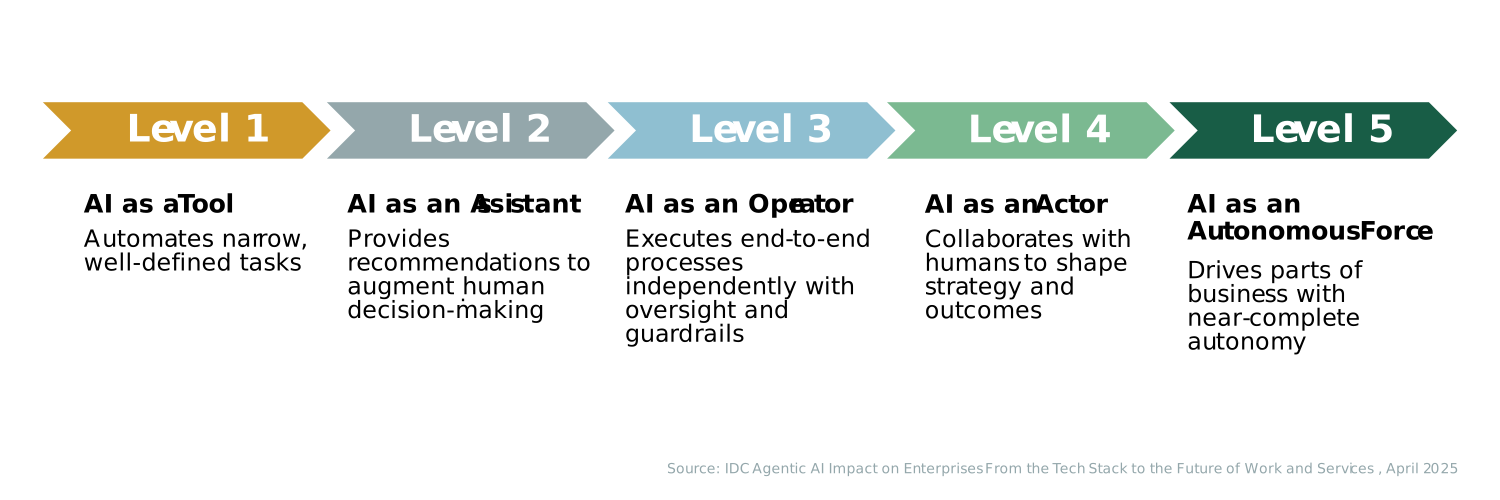
One helpful way to understand enterprise progress is through the AI maturity curve, which reflects how organizations evolve from experimenting with AI tools to embedding AI directly into how work is executed.
Most organizations have made real progress using AI as a tool (Level 1) or assistant (Level 2). But many are still working to translate promising pilots into enterprise impact. They demonstrate progress at the pilot stage but struggle to move beyond contained use cases due to governance gaps, data readiness challenges, and operating model misalignment.
Performance separation in 2026 will increasingly come from advancing up the maturity curve toward AI as an operator (Level 3), where AI executes end-to-end processes with appropriate oversight.
Organizations making this shift are investing in the operating capabilities required to support it, while others remain concentrated in earlier stages focused primarily on experimentation.
Success at this level requires redesigning the operating systems that underpin how work gets done.
As we highlighted in our 2026 Tech Industry Insights Report, the organizations separating from peers this year are those investing in the capabilities required to support that shift.
# Why Most AI Programs Underdeliver: The Clarity Gap and Pilot Purgatory
When AI initiatives are divorced from corporate strategy, organizations experience a familiar pattern: fragmented experimentation, unclear ownership, and isolated metrics that fail to demonstrate enterprise value.
Even where leaders believe alignment exists, execution often breaks down. Strategy is declared but not translated into a measurable portfolio of bets tied directly to KPIs.
This creates pilot purgatory — pilots succeed technically, but fail to secure the budget, data access, governance, and change support required to scale across the enterprise. Teams measure tokens saved or model accuracy, while the business asks different questions: Did we improve cycle time? Reduce risk? Increase revenue or retention? If you can’t connect AI to outcomes, ROI remains elusive.
71% of leaders report their AI efforts are aligned with their overall business goals, but only 31% have actual metrics tied to key performance indicators.²
# AI Doesn’t Create Dysfunction, It Reveals It
One of the most important lessons we see across industries is that AI does not introduce new weaknesses into an organization. It surfaces the ones that already exist: scattered knowledge, unclear decision boundaries, broken processes, inconsistent data, and misaligned incentives.
As AI becomes embedded across workflows, those gaps become harder to ignore.
That’s why adding AI to old ways of working rarely succeeds. To realize value, organizations must treat AI as a catalyst for reengineering how work happens.
Reengineering how work happens requires strengthening a set of core enterprise capabilities.
At Propeller, we frame AI value realization around six transformation focus areas. Together, these represent the enterprise capabilities required to convert AI potential into sustained performance.
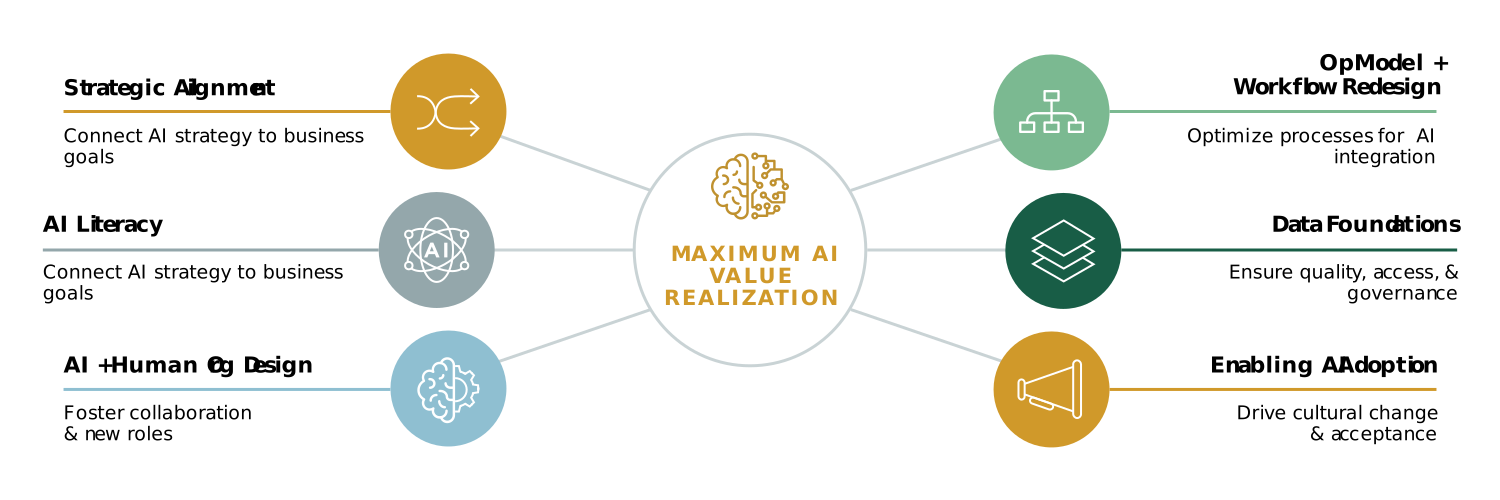
These six areas represent the foundation required to scale AI effectively, but sequencing them correctly is what determines whether they translate into real impact.
We’ve outlined a simple checklist to help leaders assess where their organization stands across each of these areas.
# Six Transformation Moves That Unlock Real AI Impact
# 1 | Shift From AI Strategy to Strategy With AI
AI should not be a bolt-on roadmap. It should influence how corporate strategy is built and executed. The practical shift is from asking “How do we use AI?” to “How does AI accelerate or transform our strategic imperatives?”
High-impact organizations:
- Educate leaders on the art of the possible during planning so they can challenge assumptions and targets.
- Establish governance where AI funding depends on a clear business case tied to strategic KPIs.
- Run AI as a value-based portfolio, stopping underperforming efforts quickly and doubling down on those gaining traction.
This shift is how you avoid fragmented experimentation and build an enterprise North Star that teams can execute against.
While 80% of C-suite leaders report having a clear organizational-wide AI strategy, only 68% of senior tech managers agree, indicating gaps in alignment and understanding that could hinder execution.³
# 2 | Build AI Literacy Across Your Entire Enterprise, Not Just in Your Tech Team
Scaling AI is no longer just about the technology team. It requires building AI literacy across the entire workforce. Many organizations cite skills shortages as a barrier to scale and even abandon initiatives due to a lack of capability.
In our recent People & Change research, lack of expertise or training and employee resistance were the two most frequently cited barriers to AI adoption.
What AI literacy really means is both:
- Strategic literacy: Understanding where AI creates value, how economics change from pilot to run, build vs. buy tradeoffs, risk and governance considerations, and how AI reshapes roles and operating models.
- Tactical literacy: Mastering prompting fundamentals, evaluating output quality and accuracy, designing human-in-the-loop workflows, and understanding common failure modes.
Effective capability building requires hands-on, relevant, collaborative learning that moves teams from awareness to confident execution. Right now, most organizations aren’t there—75% of data leaders say their workforce needs stronger AI and data literacy to operate effectively day to day.
# 3 | Treat Adoption As Continuous Enablement, Not Change Management Once
AI often appears as a technical project, but it is fundamentally a human transformation. AI changes fast, meaning enablement must be continuous rather than a one-time launch activity.
Traditional change management is front-loaded and time-bound. AI value, by contrast, is realized through real-world usage, measurement, refinement, and expansion. This requires an AI enablement cycle that mobilizes and aligns early, architects guardrails and workflows, implements new behaviors, stabilizes and validates value, and then sustains success through ongoing governance and enablement.
Enablement that scales typically includes:
- Embedded guardrails and verification in daily work (risk protection)
- Adoption and workflow consistency metrics (not vanity usage stats)
- Feedback loops, champions networks, and continuous playbook updates as tools evolve
Organizations that get this right stand out — AI high performers are 3x more likely to have leaders actively driving adoption.


# 4 | Modernize Data Foundations: Trust Is the Currency
As AI shifts toward smaller, curated models and context-aware intelligence, proprietary, high-quality data becomes the competitive moat. But data readiness remains one of the biggest bottlenecks, and poor data quality can prevent projects from moving to production.
In practice, data foundations mean more than a platform. They require:
- Governance with clear roles, responsibilities, and decision authority, so trust is earned and maintained.
- A phased approach that secures early wins, then formalizes and scales practices over time.
- DataOps-style iteration that understands business context, assesses the data landscape, prepares pipelines and metadata practices, and productizes for ongoing governance.
When trust is weak, adoption stalls. When trust is strong, autonomy can increase responsibly.
Poor data quality continues to be a primary obstacle to AI success, with 57% of leaders viewing data reliability as a key barrier to moving AI projects from pilots to production.⁴
# 5 | Redesign the Org for Human-Agent Collaboration
AI agents are more than traditional software tools. They behave more like digital employees, taking responsibility for tasks, needing oversight, and requiring integration into team operating rhythms.
Agentic AI is already pressuring org charts. Scaling requires:
- A work chart view of how work actually gets done, so organizations can decide where agents can own, co-own, or augment steps.
- Clear contracts between humans and agents with defined responsibilities, guardrails, escalation paths, and accountability for outcomes.
- Manager enablement that crystalizes when to use AI, how to review outputs, how to coach teams, and how to handle risk basics.
This is also where trust matters. Workers’ concerns about AI and jobs are real, and leaders must engage transparently and build confidence through clarity and capability.
# 6 | Go Workflow-First: Rebuild Processes Around AI Capabilities
Layering AI on top of old processes is a recipe for failure. Real value requires workflow redesign. Early AI gains were often isolated to individuals or small teams. To scale impact, organizations must reinvent end-to-end workflows, especially where agents can orchestrate across systems, teams, and data.
The organizations best positioned to realize the value of AI as an operator tend to:
- Redesign end-to-end processes from the ground up based on what AI does well today, and what it will likely do well in the future.
- Clarify decision rights and escalation paths as autonomy increases, ensuring humans remain accountable for outcomes.
- Align operating model and delivery rhythms (e.g., agile structures, cross-functional ownership) to support continuous iteration.
The organizations seeing meaningful EBIT impact are more likely to fundamentally redesign workflows because they don’t treat AI as a tool. They treat it as an operating model shift.
Only 24% of companies report achieving ROI across multiple use cases, largely because they treat AI as a tool rather than an operating model shift.⁵
# What To Do Next: A Practical Path From Momentum to Sustained Value
If your organization is serious about impact in 2026, the question isn’t “Which model?” It’s “What operating capabilities must we build so AI reliably delivers outcomes?” That means sequencing the work: aligning strategy and investment, building literacy, enabling adoption with governance and measurement, modernizing data foundations, redesigning roles and workflows, and establishing a continuous improvement system.
Propeller partners with leaders to connect AI to corporate objectives, translate pilots into repeatable operating rhythms, and design the workflows, skills, governance, and structures required to scale.
If you’re ready to move from pilot momentum to measurable performance, we’d welcome the conversation. Bring one of your stalled initiatives, a function you’re working to transform, or your 2026 AI investment portfolio. Together, we’ll identify where value is leaking and design the transformation moves that turn AI potential into measurable business performance.
AI value doesn’t come from doing more — it comes from focusing on the right foundations in the right sequence. If you’re evaluating where your organization stands, use our checklist to identify what comes next.

Scaling AI Starts with the Right Sequence
Use this checklist to assess where your organization stands, and what comes next.
- https://www.mckinsey.com/capabilities/quantumblack/our-insights/the-state-of-ai-how-organizations-are-rewiring-to-capture-value
- https://www.lebow.drexel.edu/sites/default/files/2026-01/lebow-precisely-state-data-integrity-ai-readiness-2026.pdf
- https://assets.kpmg.com/content/dam/kpmgsites/xx/pdf/2026/01/global-tech-report.pdf.coredownload.inline.pdf
- https://www.lebow.drexel.edu/sites/default/files/2026-01/lebow-precisely-state-data-integrity-ai-readiness-2026.pdf
- https://kpmg.com/xx/en/our-insights/ai-and-technology/global-tech-report.html


