

Business leaders are being asked to make decisions faster, with less certainty and higher stakes than ever before.
As pressure increases, teams often weigh more inputs, seek broader alignment, and try to avoid missteps, but frequently this leads to circular discussions and a lack of clear direction that slows decision-making.
Design thinking gives leaders a more effective way to approach these decisions, helping teams make progress without sacrificing rigor.
# Why Traditional Decision-Making Breaks Down Under Uncertainty
Traditional decision-making often relies on deep analysis, broad consensus, or gut instinct — approaches that work best when the path forward is relatively clear. When uncertainty increases, however, these methods tend to slow teams down. Analysis expands in search of certainty, alignment becomes harder to reach, and risk avoidance creeps in.
Today’s environment makes this kind of uncertainty more common. Faster innovation cycles, sustained market pressure, and the expanding use of AI introduce more unknowns into everyday decisions, leaving leaders with fewer clear answers and less time to find them.
Related Read: How to Balance Top-Down Decision-Making and Bottom-Up Innovation
Design thinking provides a more
effective way to make progress in these moments, helping teams move forward
deliberately even when the answer isn’t obvious. It brings creativity into decision-making as a practical way to
navigate uncertainty, without losing discipline or momentum.
# What Is Design Thinking?
In the context of decision-making, design thinking is less about generating ideas and more about creating structure around uncertainty. It provides teams with a disciplined way to explore possibilities, test assumptions, and make progress when the right answer isn’t immediately clear. Rather than pushing teams toward a single, premature answer, it creates space to examine options before committing to a path forward.
By intentionally building in time for exploration and iteration, design thinking reframes how teams and leaders think about efficiency. Rather than equating efficiency with speed or minimal effort, it emphasizes the value of investing time upfront to avoid missteps later—conserving resources by increasing the likelihood of meaningful, high-impact outcomes.
The approach was popularized in the 1990s by IDEO founder David Kelley and his colleague Tim Brown as a way to apply designers’ methods to complex problem-solving. Today, it’s used across industries, roles, and problem types to help teams navigate ambiguity and move forward with confidence.
Related Read: Designing Change: Applying Design Thinking to Change Management


# Three Ways Design Thinking Supports Smart Decision-Making
In our work with leadership teams, we see three ways design thinking helps teams break decision stalemates, surface better options, and align on a clear path forward.
# 1. Design Thinking Breaks Decision Stalemates
Overthinking can paralyze a team. Using design thinking for decision making encourages quick starts, prototypes, and small tests. When teams embrace experimentation and view “redoing” as progress, they build the momentum and confidence needed to make smarter decisions faster.
Propeller found this to be the case when helping a cross-functional steering committee achieve agreement in the final days of a future-state mapping project. With only five days left on the project, the group could not reach consensus on final recommendations and journey blueprints. Indecisiveness risked derailing the entire project. Instead, Propeller applied a lightweight, binary decision framework, helping the team reach 14 aligned decisions in just 60 minutes.
# 2. Design Thinking Opens Up Better Solutions
Sometimes teams bring assumptions, past patterns, and even ego into their decision-making. Because design thinking emphasizes the process of discovery rather than rushing to deliver the “best” idea, it encourages teams to separate the problem from their personal preferences. The result is higher-quality decisions and a broader exploration of possibilities.
This played out for one organization within its talent acquisition function. As the team prepared to launch a new technology to improve the candidate experience, they engaged Propeller to run a discovery process to ensure the tool was optimized for users. That work revealed a different challenge: confusion around internal roles and responsibilities — not a lack of technology — was the primary driver of poor candidate experiences. The team had arrived with an assumed solution before fully understanding the problem.
A design thinking approach helps prevent this. By leading with curiosity and investing in discovery, teams ensure they are solving the right problems, not just the ones they assume they have.
# 3. Design Thinking Tools Create a Shared Vision
Design thinking tools, such as storytelling, journey maps, and rapid prototypes, create a shared vision by making ideas tangible and visible. When teams are debating abstract concepts, these tools allow everyone to see the same story, react to the same artifacts, and co-create a unified understanding of the problem and potential solutions. This shared understanding helps teams surface disagreements quickly, refine their thinking, and make decisions more effectively.
These tools only flourish when leaders intentionally create the space for them to thrive. When leaders model curiosity, encourage exploration, and make room for iterative learning, they unlock the collective creativity of their teams and pave the way for faster, better decision-making
# What Needs to Be in Place for Design Thinking to Work
For design thinking to work in practice, teams need a few foundational conditions in place. These essentials include:
- A willingness to prioritize testing over debate.
- Psychological safety that encourages team members to offer ideas and challenge assumptions.
- Leadership’s sponsorship of iteration.
- An openness to revisiting and refining previously made decisions.
When these conditions are present, teams are better positioned to use design thinking as a practical decision-making approach.
Related Read: Why Service and Product Innovation Efforts Stall and What High-Performing Organizations Do Differently
# Propeller's Design Thinking Approach
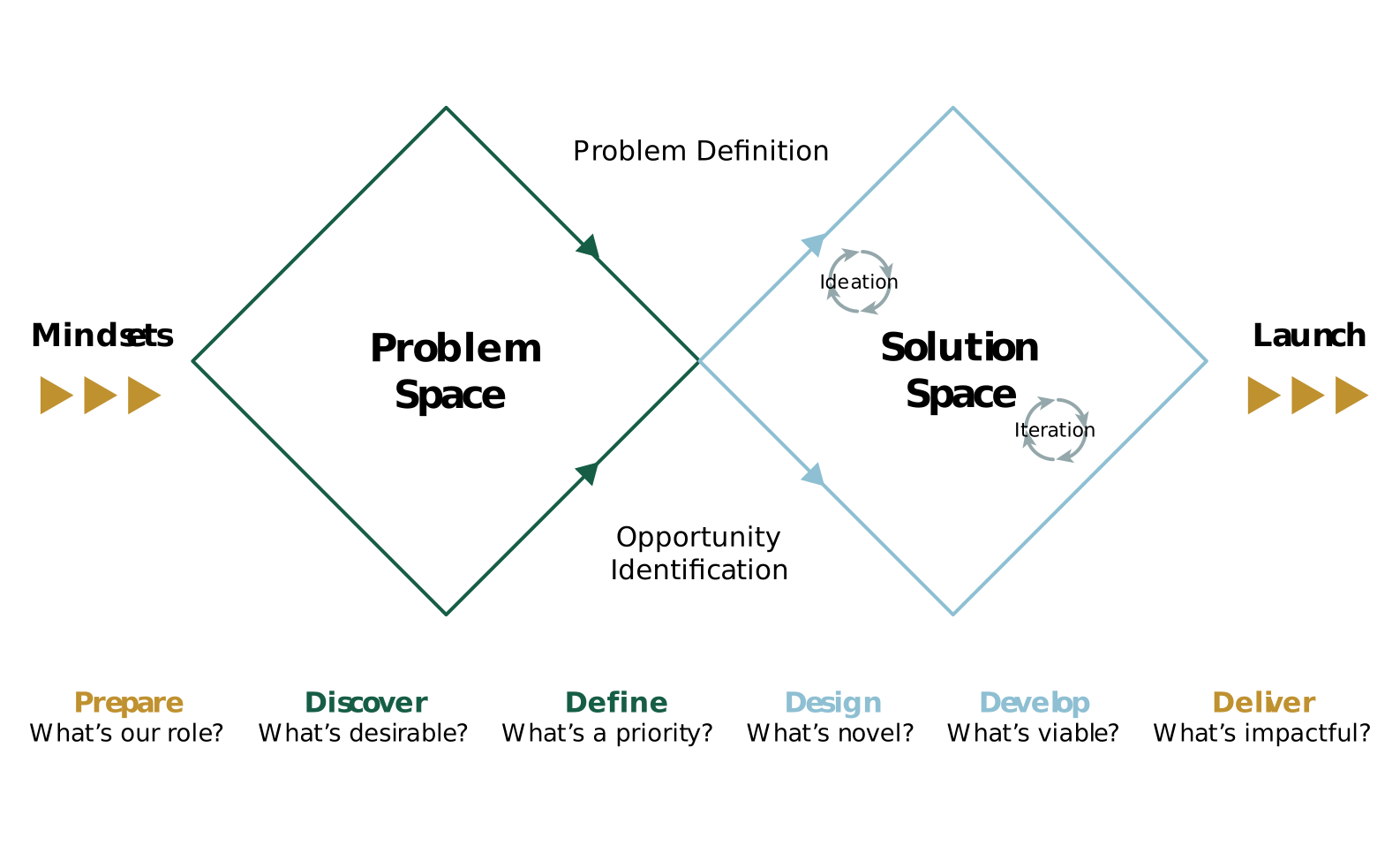
At Propeller, we use a simple six-step design thinking methodology that helps teams move through iterative decision-making with speed, clarity, and alignment.
- Prepare: Align on goals, constraints, and decision-makers.
- Discover: Identify insights and risks to prevent wrong turns.
- Define: Clarify the real problem and success criteria.
- Design: Explore multiple solution paths quickly.
- Develop: Test, validate, and refine toward the right option.
- Deliver: Make the decision with confidence and move into execution.
This structure prevents teams from getting stuck in circular debates and make decisions more effectively.
# You’re Probably Already Doing Pieces of This — Now Make It Intentional
Not sure if using design thinking for decision-making will work for your team? Take a moment to challenge that assumption by thinking about all of the ways you’ve seen small changes snowball, driving substantial progress over time. Many leaders already engage in mini-iterations, feedback loops, quick tests, and alignment moments. Design thinking simply makes this repeatable, structured, and intentional. By deliberately giving space, time, and free rein to teams’ innate curiosity, organizations can innovate at an entirely new scale.
# Ready to Move a Decision Forward?
When teams get stuck, the challenge is rarely a lack of effort or expertise — it’s figuring out how to make progress when the answer isn’t clear. Design thinking offers a practical way to work through those moments and make better decisions along the way.
At Propeller, this mindset shapes how we partner with teams across all kinds of work, helping leaders navigate uncertainty and move decisions forward when it matters most.
Ready to move forward? Let’s discover what’s holding your team back.


